
Jan 25, 2026
Costs: Ozone Water vs Osmosis Water for Surface-Cleaning Teams
A practical cost breakdown for professional surface cleaning: how ozone water and osmosis (RO) water differ in ongoing effort, consumables, and workflow time.
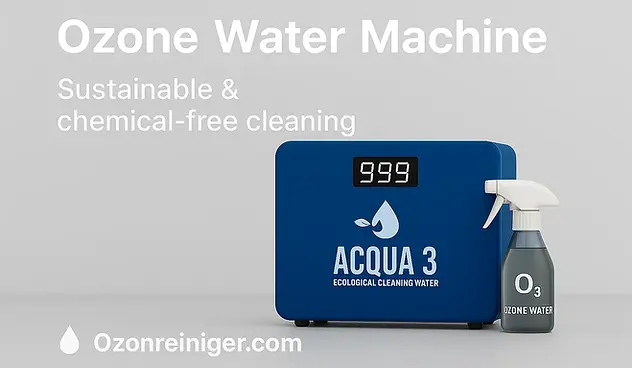
Costs ozone water vs osmosis water (RO): compare ongoing effort, consumables, downtime and workflow time for professional surface cleaning routines.
Cost comparison that matches real workflows
Costs in the real world: what you should actually compare
When teams compare ozone water and osmosis (RO) water, the discussion often starts with “which water is cheaper?”. In professional surface cleaning, that question is too narrow. The real cost is driven by workflow time, maintenance workload, and how stable the routine stays when multiple people run the same rounds.
Important: this article is only about surface cleaning. No claims about consumption or medical use.
Two systems, two cost profiles
Ozone water is typically generated on demand and used immediately in the round. In many facilities that means less handling: generate, apply, wipe, move on. RO water is produced through filtration and membranes. It can be excellent for finishing, but it introduces a chain of parts and routines (filters, membranes, flushing cycles, monitoring) that carry ongoing cost and time.
The 4-bucket model: a cost comparison teams can use
If you want a comparison that survives daily reality, split costs into four buckets. This makes decisions repeatable, even across sites and teams.
- Time per round: minutes added or removed by handling, switching steps, or waiting for output.
- Consumables & service: planned checks, parts, filters, membranes, and service intervals.
- Logistics: installation, transport, storage, and any extra setup that slows the round.
- Consistency: how predictable the finish stays without constant correction or re-training.
1) Time is usually the biggest cost driver
In most businesses, labor time dwarfs equipment cost. A one-minute delay per round becomes significant when a team runs many rounds per day. Ozone water often reduces “micro-delays” because it fits a simple sequence: produce and use. RO routines can add time through additional steps (routing, checking output quality, and dealing with variability as membranes age).
For visible surfaces like glass and stainless steel, time is also shaped by your cloth routine. With a consistent wipe-and-dry approach, many teams get a clean, clear finish with ozone water—without turning the whole round into a dedicated finish process. A practical standard is the two-cloth method: clean with cloth A, immediately dry with cloth B.
2) Consumables, parts and service: planned vs. ongoing
Ozone setups tend to concentrate maintenance around the generation unit and planned checks over runtime. RO setups distribute maintenance across filters and membranes, plus flushing cycles. The direct costs are parts and service. The indirect costs are downtime and quality drift.
For realistic intervals and what to track day-to-day, use: Maintenance & consumption: what each system requires.
3) Logistics: what happens to cost when you scale
Costs change when you scale to multiple people, multiple shifts, or multiple locations. A “perfect” solution on paper can become expensive if it adds complexity to training or introduces steps that people skip under pressure. Ozone water often scales well because it can be integrated into a consistent round without extra infrastructure. RO can scale, too—but it usually requires stricter rules and monitoring so the output stays consistent.
4) Consistency: the hidden cost of variance
Variance is expensive. If two team members do the same round differently, you get variable outcomes and repeat work. That is why many businesses choose a single base workflow and only add an RO finishing step where appearance is the KPI. Consistency comes from defined zones, defined cloth use, and a stable order of steps—more than from the water type.
When ozone water is usually the economical default
Ozone water tends to be the economical default when you have high frequency (many rounds), many contact points, and multiple staff. It supports repeatability: the same steps, the same order, and fewer moving parts in daily handling. For glass and stainless steel, ozone water can still deliver a clean, clear finish when the team consistently dries after cleaning—especially with a two-cloth routine.
When RO water makes financial sense as a defined finish step
RO water often makes sense when you define it as a finish-only step for a short list of visible surfaces (for example: entry glass fronts, stainless counters, mirrors). If the finish KPI is strict and you can absorb maintenance and monitoring, RO can be a strong addition. The key is to keep it a bounded step—otherwise it can quietly expand into the whole round and drive up time, flushing losses, and service needs.
A simple team rule to prevent cost creep
- Base round: run the entire routine with one clear process (often ozone water).
- Finish list: define a short list of surfaces that get an extra finish step (RO only where needed).
- Cloth standard: keep cloth rules simple and consistent (clean, then dry immediately).
Series links: build the full decision model
This costs article is part of the “ozone water vs osmosis water” series. Use the hub and the other subs to complete the comparison:
Hub: Ozone water vs osmosis water
Read more