
Oct 30, 2025
Ozone water vs cleaning products: costs, ease of use and results compared
The comparison between ozone water and conventional cleaning products is most informative when structured around three concrete dimensions: total costs over a period of three to five years taking into account both the purchase price of the appliance and ongoing costs, ease of use in the daily cleaning routine comparing tapping and cleaning directly with dosing and storing multiple bottles per surface type, and the quality of the cleaning result on the most common surfaces in a home weighing the absence of chemical residues against effectiveness on stubborn stains. This page provides the structured comparison per dimension, names the variables that differ per household and gives a practical guide for the personal calculation. The goal is not to designate a winner but to enable the user to make the comparison based on their own specific situation. After this page, it is fully clear along which three criteria the choice is best made, which variables weigh most heavily per household in those criteria, and how one's own specific situation compares to the profile where ozone water is the clearly better daily choice versus the profile where conventional cleaning products remain the more appropriate, flexible and cost-effective choice for the specific household.
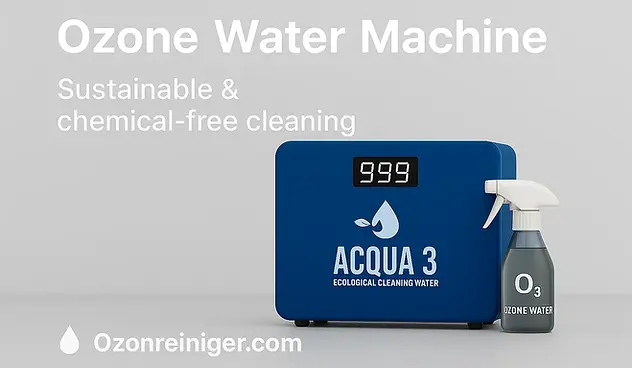
Ozone water vs cleaning products: structured comparison of costs over five years, ease of use in the daily routine and cleaning result per surface type.
Questions about the comparison between ozone water and cleaning products?
How to read the comparison
This comparison is not a judgement but an instrument. The three dimensions, costs, ease of use and result, are each separately relevant depending on which factor weighs most heavily for the specific user. Those who compare primarily on costs look at the payback period. Those who compare primarily on ease of use look at the daily routine. Those who compare primarily on result look at the surface type.
This subpage belongs to the hub is an ozone water device worth it. The preceding usage cluster is accessible via ozone water device usage guide. For context on available models, the ozone water machine page offers supplementary information.
Comparison 1: Costs over five years
The total cost comparison over five years consists of three components. For ozone water: one-off purchase price plus annual maintenance costs of around fifteen euros for a generator cell cleaning, plus minimal energy costs. For conventional cleaning products: zero purchase threshold plus monthly purchase costs multiplied by sixty months.
Example at fifteen euros per month on cleaning products: over five years that is nine hundred euros. A two-hundred-euro appliance plus five years of maintenance costs of seventy euros is two hundred and seventy euros total. Difference in favour of ozone water: more than six hundred euros over five years. At five euros per month on cleaning products: three hundred euros versus two hundred and seventy, barely any difference. The break-even point lies at around eight euros per month of cleaning product use for a two-hundred-euro appliance.
Comparison 2: Ease of use in the daily routine
Ozone water in the daily routine: activate appliance or open tap, tap working liquid, apply two-cloth method, done. No opening bottles, no dosing, no putting back. The action takes five seconds per tapping moment. The two-cloth method itself takes one to two minutes per surface.
Conventional cleaning products in the daily routine: choose the right bottle, open, dose on cloth or surface, wipe, possibly rinse, close bottle and put back. For multiple surfaces, multiple products are needed. Time investment per cleaning session is higher. The two-cloth method illustrates the difference concretely in daily practice.
Comparison 3: Cleaning result per surface type
On daily deposits on countertops of stone, composite or laminate, dining tables, mirrors and bathroom surfaces: ozone water gives a good residue-free result that is equivalent to most multi-surface cleaning products. The advantage of ozone water is the absence of a film layer or residue after use.
On stubborn dried-on stains, burnt-on hob residues, lime scale of weeks old or mould spots in grout: conventional cleaning products with specific active ingredients perform better. Ozone water is here a supplement for rinsing fresh spots but not a replacement for the initial treatment. This distinction is the most relevant criterion for deciding which system suits one's own cleaning tasks.
Calculating the payback period for one's own situation
The calculation needs four input values. Step 1: current monthly spend on cleaning products in euros. Step 2: purchase price of the desired appliance model in euros. Step 3: estimated annual maintenance costs of around fifteen euros. Step 4: divide the purchase price by the monthly saving on cleaning products. The result is the payback period in months.
Example: appliance two hundred euros, current cleaning product spend thirty euros per month, estimated ongoing cost two euros per month with ozone water. Monthly saving twenty-eight euros. Payback period: two hundred divided by twenty-eight is seven months. After seven months the appliance is paid back and each month delivers net saving.
When does ozone water win the comparison?
Ozone water wins the cost component with monthly cleaning product spend above the break-even point, with daily use over several years and with an appliance that lasts a long time. Ozone water wins the ease of use component for virtually every daily user who currently maintains multiple products. And ozone water wins the result component for users who primarily do daily upkeep and do not have a stubborn stain routine.
For questions about the calculation for one's own situation, contact is available. The benefits are further detailed at benefits ozone water device.
When do cleaning products win the comparison?
Cleaning products win the cost component with low monthly spending below the break-even point. They win the ease of use component for those who already have a simple routine with few products. And they win the result component for those who regularly treat stubborn stains requiring specific chemical products.
Cleaning products also win the accessibility component: no initial investment, no fixed water connection needed, no maintenance. For those who want to start quickly without a threshold, cleaning products are the simplest starting point. The disadvantages of the ozone water device are further detailed at disadvantages ozone water device.
Hybrid approach: combining both systems
Many users combine both systems in practice. Ozone water for daily upkeep of countertops, tables, bathroom and mirrors. Conventional cleaning products as a supplement for weekly or monthly more thorough cleaning of the hob, sanitary ware and grout. This combination gives the best of both systems: the routine simplification of ozone water for daily use and the effectiveness of chemical products for periodic intensive cleaning.
Those who use the hybrid approach significantly reduce cleaning product use but do not replace it completely. The cost saving is proportionally smaller but still real with daily use of the appliance. For more context, ozone water device tips offers supplementary information on optimising daily use.
The role of water hardness in the comparison
Water hardness is a variable that affects the maintenance cost of the ozone water device. In hard water regions, more frequent generator cell cleaning is necessary: up to four times a year instead of twice. This slightly increases annual maintenance costs but does not fundamentally change the outcome of the cost comparison.
Those who live in a hard water region and are considering purchasing the appliance factor in the higher maintenance frequency when calculating the payback period. The impact is typically limited to a few months of additional payback time. For questions about water hardness and its consequences for maintenance, contact is available.
Comparison based on surface cleaning frequency
Those whose largest cleaning area in the home is countertops, tables and the bathroom benefit most from ozone water for daily use. Those whose largest cleaning area is the hob, grout and tiles with lime scale more often need chemical products as a supplement. The ratio between both surface types partly determines how large the advantage of ozone water is in practice.
For those with a mixed kitchen featuring both smoother and rougher surfaces, the hybrid approach is most effective. Ozone water daily on the smooth surfaces, chemical product weekly or monthly on the rougher surfaces. The two-cloth method applies for all smooth daily surfaces. The guides section offers supplementary overview per cluster.
The comparison viewed over multiple years
Over one year the comparison is neutral or slightly in favour of ozone water for many households. Over three years ozone water clearly wins for households with monthly cleaning product spending above the break-even point. Over five years the difference is substantial for daily users with high cleaning product consumption.
Those who use long-term costs as the deciding criterion choose on the basis of the five-year calculation. Those who make the decision primarily on the basis of the first year have a neutral or slightly negative picture of the cost comparison. The time horizon chosen therefore has a large influence on the outcome of the comparison. For further context, the pages benefits and drawbacks are also relevant.
💬 A user who made the comparison after twelve months of use: "I now spend two euros per month on cleaning products instead of forty euros. The appliance cost two hundred euros. Paid back in six months." A user who uses the hybrid approach: "The appliance does the daily cleaning. For the weekly thorough clean I still have one bottle of cleaning product in the cupboard." For questions, contact is available.
The comparison summarised in a decision tree
Question 1: Do you clean daily or almost daily? Yes: go to question 2. No: cleaning products are likely the better choice for your usage profile. Question 2: Do you spend more than ten euros per month on cleaning products? Yes: go to question 3. No: the payback period is long and ozone water is less attractive on cost. Question 3: Do you have a suitable water connection or tap type for the appliance? Yes: ozone water is for you the strongest choice on the basis of the three comparison dimensions. No: see the alternatives subpage for other options.
This decision tree is a simplification but gives a direct outcome for most users. For situations that do not fit this tree, contact offers a personal answer. The alternatives subpage addresses options for those rejected by the decision tree at question 3.
Conclusion of the comparison
Ozone water wins the comparison on three of four assessment criteria for daily users with monthly cleaning product spend above the break-even point. Cleaning products win on the accessibility component and on specific cleaning tasks where chemical active ingredients are needed. The hybrid approach combines the strengths of both systems for those who do not want to switch completely.
The choice is situation-dependent and personal. Neither system is universally better. Those who make the comparison honestly based on their own situation find the answer that fits. The guides section offers the complete overview for further exploration of all clusters.
Further reading
This page belongs to the hub is an ozone water device worth it. The preceding usage cluster is accessible via ozone water device usage guide. For the full assessment, benefits, drawbacks and alternatives are also available.
The guides section offers the complete overview of all clusters for further exploration.